
A very common mistake young writers make is to include a quote in your writing and then just leave it there to die, without examining it at all. Any time you include a quote, your next step is to break it down – to show EXACTLY what is important about those words in particular. The most common errors with quote misuse are:
1) Including a quote and then discussing the scene that surrounds it instead of the line(s) you included
2) Including an “important quote” that you found on some website, but it doesn’t really support your argument
3) Including a quote and then moving on entirely (this often indicates that the quote doesn’t have much you can dissect)
4) Including a quote and then paraphrasing it, as though your reader doesn’t understand the meaning or context
5) Including a quote and then pulling words out of the quote and using them in your sentence without actually examining them. (e.g. The speaker hears a sound that reminds him of a “shield of brass” that fell “heavily” on the floor.)
6) Including a quote and then hanging 100% of your analysis on a single (often loaded) word or phrase. (Of everything on this list, this is the one that can sometimes be acceptable. The single-word analysis is a problem when either (A) the interpretation doesn’t make complete sense on its own – you are forcing a convenient interpretation onto the word, or (B) the rest of the quote doesn’t support this single word/phrase and it feels cherry-picked, or (C) the significance of the single word is really obvious and doesn’t need explaining, which ultimately makes the argument unconvincing.)
The following is a five-step process suggested by Luna Laliberte from the Writers’ Center at Rutgers which ensures that you are finding a quote that fits with your essay and are breaking it down thoroughly. If you wish to see the original page, with examples, CLICK HERE.
STEP ONE – WRITE THE QUOTE DOWN
Not only does this help solidify the quote in your mind, but it also allows you to do the next step…
STEP TWO – UNDERLINE THE KEY WORDS
Simply put, what are the most important words in this line? What grabs your attention? This could be a word choice, a repetition, a structural choice, or something unsaid. Don’t overdo it by underlining huge phrases or complete sentences – the point here is to REDUCE the quote to its most important parts. On the other hand, if you don’t underline enough pieces, you might not have much to say. You should aim for AT LEAST FIVE words or phrases or elements that you underline. Again, the key here is to be BRIEF – don’t underline full sentences or clauses – try to avoid anything longer than 3-4 words.
STEP THREE – PARAPHRASE AND DEFINE THE KEY WORDS/PHRASES
Here, you process and break down the important parts of the quote. Simply translate. Don’t intepret yet.
STEP FOUR – CONNECT WORDS TO ONE ANOTHER
Take the words you underlined, select one, write it, add a plus sign, then choose a second underlined word. Do this as many times as you need to (possibly including connecting the same starting word with different other words). See what jumps out with some of these pairings – you might not use all of them, but you might also find something that really stands out. A pattern. A contradiction (the + sign is simply connecting words, not suggesting they are equivalent). A shift. (If it works, you can make these a list of three or more words that work together). You can also indicate structural aspects of the quote, not just phrases (e.g. “simple diction + complicated diction”)
STEP FIVE – CONNECT THE TERMS BACK TO THE QUOTE, AND TO YOUR MAIN POINT
Here is where the battle is lost or won. Now you have a lot of TEXT-SPECIFIC observations. If you aren’t using them to prove your initial point (or what’s more, your thesis), then this might feel like a good, but confusing and rootless close reading exercise. To quote Ms. Laliberte: “Think about what the author is conveying here. Think about the main idea you, as a reader, are supposed to get from this quote. You can move from here to write about this quote in the context of your thesis. How does this defend or contradict your argument? What main idea is conveyed that also applies to your thesis?”
AN EXAMPLE (STEPS 1-4)
Presume that this quote work is in support of an analysis of Edgar Allan Poe’s short story “The Fall of the House of Usher” that argues the following thesis: Poe uses sensory imagery to create tension in this story to warn about the dangers of refusing to acknowledge your flaws.
Step one: Blue
Step two: Green
Step three: Red
Step four: Pink
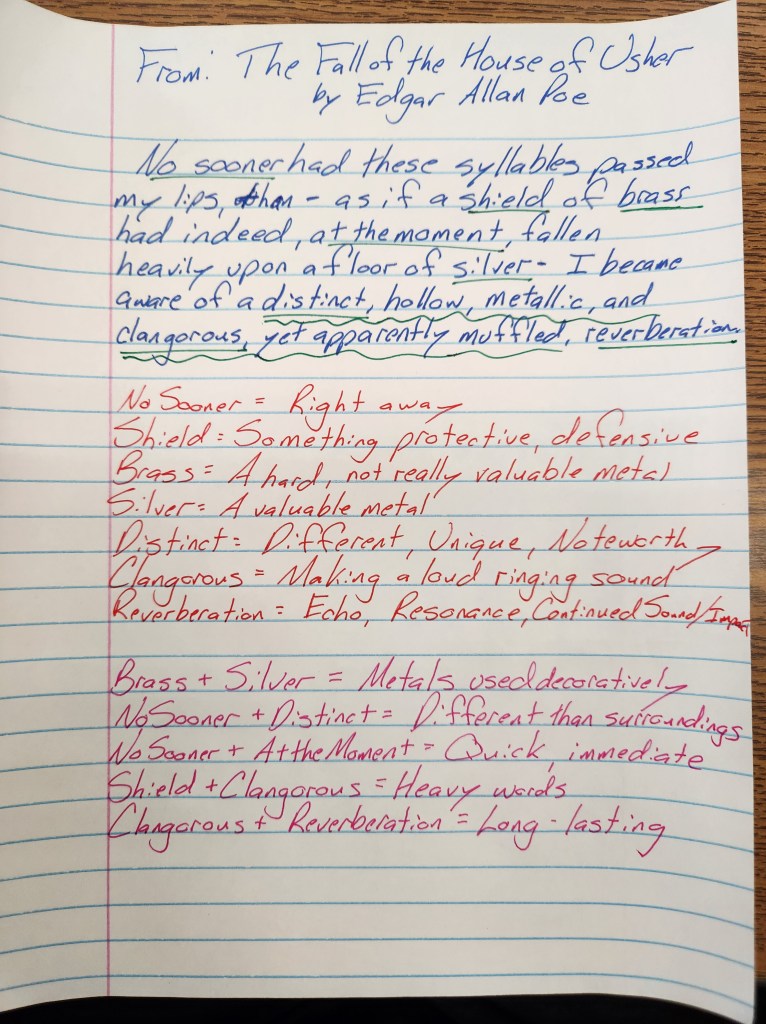
ANALYSIS (STEP 5)
(This dissection would immediately follow the quote in the essay – it is the Analysis step of SPEAC.)
In this moment, the narrator begins to realize how corrupt Roderick Usher is, and begins to distance himself from his friend. Poe contrasts words that suggest quickness (“No sooner,” “at the moment,”) with words that connote a longer echoing (“clangorous,” “reverberation”) to suggest that the tone of the moment has changed, and that the narrator is learning about something long-lasting. He reinforces this echoing by shifting from a quicker sentence at the start of the scene to a longer description that carries a list of five adjectives to describe the reverberation. Poe suggests the tone grows ominous through the use of words that imply heaviness, like “shield” and “clangorous,” and provides a series of words that suggest contrast; “at the moment” makes the sound appear sudden, and he describes the metallic sound using two metals of contrasting color and value.
WHOA! LOOK AT AT THIS TEXT-SPECIFIC ANALYSIS!!! Notice how you can choose to put your subquotes in parentheses after your argument, or in your own sentence, whatever seems more natural. And all of this argument supports that initial point (the first sentence). In every case, the analysis goes further than indicating a single loaded word, and explains exactly what is significant about that part of the quote. Most importantly, it gets close to the text and shows how Poe’s WORD CHOICE (not just his plotline) proves the thesis.
NOTE: We are not expecting this much depth in your analysis of every quote. You only have so much room to work with. But a solid quote can absolutely hold up to this much scrutiny.
Poor quote analysis, from the list at the top of this page, would look like the following – these lines would immediately follow the Poe quote included above:
Problem #1 (discussing the scene instead of the quote): This moment is when the narrator hears a sound that ends up being Roderick’s sister crawling out of an entrapment. Roderick didn’t expect his sister to make this noise, which suggests that his past is haunting him.
Problem #2 (the Shmoop quote, forced in awkwardly): Poe begins this story with “I looked upon the scene before me—upon the mere house, and the simple landscape features of the domain—upon the bleak walls—upon the vacant eye-like windows—upon a few rank sedges—and upon a few white trunks of decayed trees—with an utter depression of soul.” The repetition and the imagery (“bleak walls,” “rank sedges”) suggests that people should learn from their flaws.
Problem #3 (moving on): Another moment that suggests how people need to confront their flaws occurs earlier in the story, when the narrator arrives.
Problem #4 (paraphrasing): In this moment, the narrator finishes speaking and hears a distant sound that makes a long-lasting noise.
Problem #5 (unexplained subquotes): The speaker hears a sound that reminds him of a “shield of brass” that fell “heavily” on the floor.
Problem #6 (the loaded word):
(A) CONVENIENT INTERPRETATION Poe’s use of “reverberations” creates a sense of horror.
(B) THE FULL QUOTE DOESN’T SUPPORT IT: Poe mentions silver as a way of showing a monetary greed.
(C) PICKING THE LOADED WORD: Poe’s use of “reverberations” suggests that the problem that just arose is impactful.
BACK to Writing
 Hopkinton High School English Department