Here’s some advice on when you have to write a response that asks you to combine your thoughts on two or three different sources. Those responses might have a great variety of topics, materials, types of writing, but they will generally fall into one of two categories: (1) Responses that ask you to read several pieces and discuss how THEY handle a common topic or idea, or (2) Responses that ask you to read several pieces and synthesize YOUR OWN RESPONSE. In either case, WHEN YOU WRITE A SYNTHESIS THESIS, BE SURE TO GO BEYOND SIMPLY SAYING HOW THE STORIES OR ARTICLES ARE FACTUALLY AND LITERALLY SIMILAR OR DIFFERENT!!
Sometimes, the synthesis essay prompt is called a “compare and contrast” prompt, which can be misleading. Sometimes a synthesis prompt is expecting a comparison, sometimes it expects a contrast, sometimes both, sometimes it leaves the choice up to you. Generally speaking, a synthesis thesis will take one of these three forms:

EXAMPLES:
“Compare” thesis: “Both Of Mice and Men and Life of Pi show how isolation causes people to lose their humanity.”
“Compare AND Contrast” thesis: “While both Of Mice and Men and Life of Pi show how isolation causes people to lose their humanity, Steinbeck blames an unaccepting society for this isolation while Martel argues that it is a self-made fault.” (This type of writing might naturally force a two-sentence thesis: One sentence to establish similarity, one sentence to establish difference)
“Contrast” thesis: “Although both Of Mice and Men and Life of Pi show the effects of isolation on an individual, Steinbeck argues that isolation causes people to surrender their goals while Martel suggests that people can only truly discover their strengths through isolation.” (the key here is that this thesis establishes what these two books argue about A COMMON TOPIC – it doesn’t just point out the many, many ways the books are different.)
NOTICE: If you are trying to discover the WHAT/HOW/WHY structure, this type of thesis is a little mystical. Your WHAT statement will show what these two stories have in common (even if you are writing a contrast essay). Isolation above is the unifying topic in all 3 theses. The HOW is pointing out how the authors handle this aspect, which is debatable – but the difficult part here is that you may need to be a bit more general at this point – otherwise, your thesis is going to become humongous, especially with a topic that asks you to respond to three or more prompts. Notice how the thesis statements above don’t get entirely specific about what EACH author says. The WHY statement most closely resembles the WHY statement of a traditional one-text thesis. What are these texts saying about this topic?
IF YOU ARE BEING ASKED TO JUDGE HOW THE PIECES TREAT THE SAME TOPIC, (e.g. “Show howDracula, Station Eleven andRebecca all use sensory imagery to create suspense”), this is a COMPARE prompt. You ought to focus on ONE story first and create an argument, then look at the next story and show how it relates to what you have already established. If you have a third text, continue going through them one at a time. Do not take on all of the texts simultaneously. As your essay progresses, you can refer BACK to a text you have already discussed, but take the texts one at a time.
A COMPARE essay will probably have a one-sentence thesis, as you are saying that both/all of the texts are arguing the same thing. CLICK HERE to see an example of an essay that scored high marks on the MCAS and notice how it creates a thesis that says what all of the stories are doing and then examines each of the three stories in the prompt one at a time.
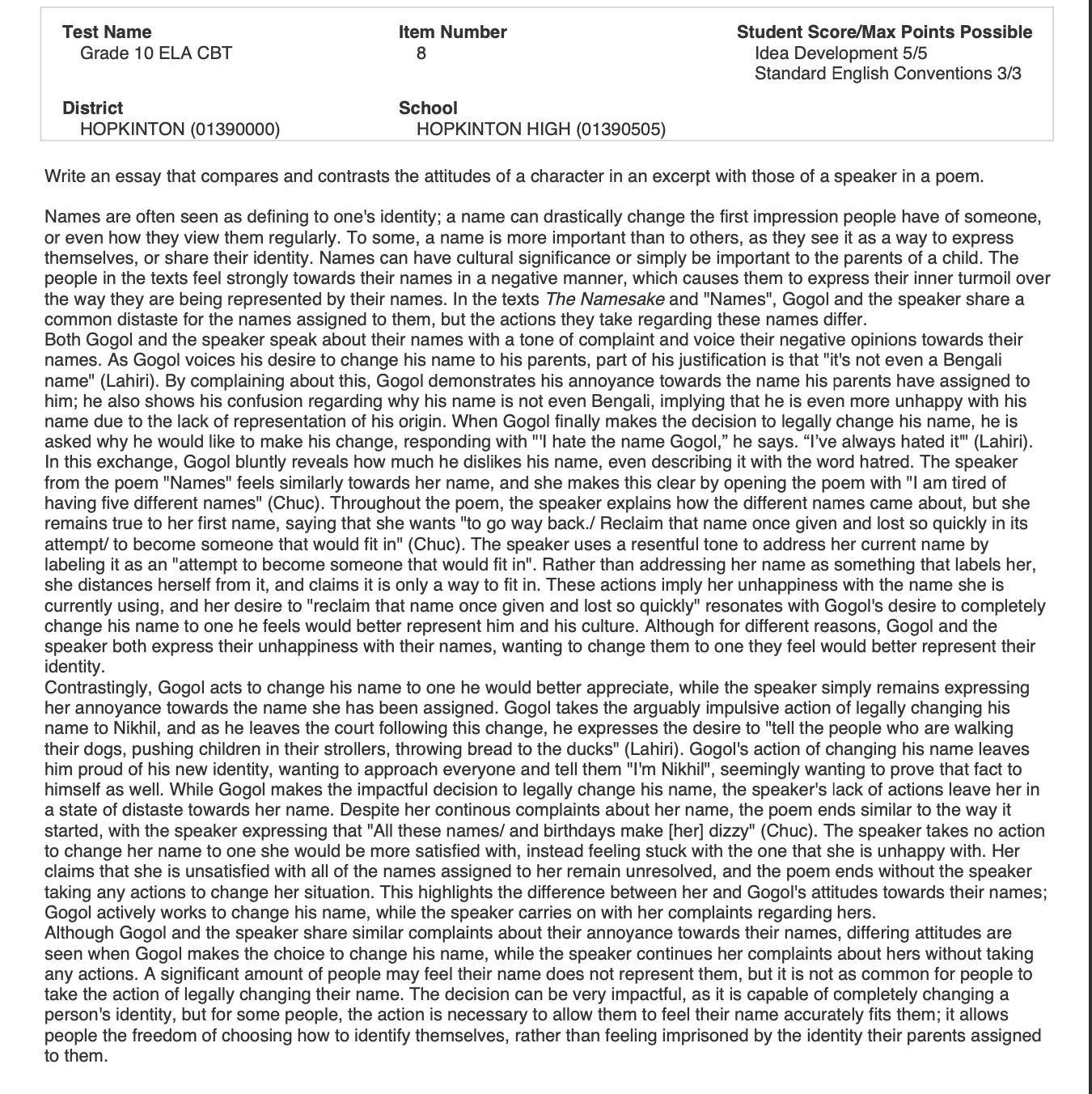
IF YOU ARE BEING INVITED TO “COMPARE AND CONTRAST,” (e.g. Based on The Namesake and “Names,” write an essay that compares and contrasts Gogol’s and the speaker’s attitudes toward their names. Be sure to use details from both the excerpt and the poem to develop your essay), this can be tricky… the prompt COULD be answered correctly if you show DIFFERENCES, *OR* if you show SIMILARITIES AND DIFFERENCES. The only wrong choice here is to neglect the “contrast” part of the prompt. Because of this potential mistake,we suggest you first brainstorm the differences and THEN consider including similarities.
When you structure a compare-and-contrast essay, it is helpful to dedicate a paragraph to showing similarities and another paragraph to showing differences, introducing both texts in your first body paragraph. This type of essay might benefit from a two-sentence thesis – one sentence to set up the similarity, a second sentence explaining the difference.
BEWARE: With the Contrast part of a “Compare and Contrast” thesis, make sure you aren’t retreating back into showing a literal difference. The contrasting part must still be a difference in the argument that the texts are making. To use the above example, it wouldn’t be a great argument if you said: “While both Of Mice and Men and Life of Pi show how isolation causes people to lose their humanity, Steinbeck introduces the element of racial bias while Martel has it occur with a character who cannot talk with anyone else.” You would just be pointing out plot facts here.
Attached below is a sample compare-and-contrast prompt from the 2023 ELA MCAS.
Here is a sample compare-and-contrast response to this writing prompt, written by an HHS student. It scored an 8, which is a perfect score. Notice how it establishes the similarity first, then spends a paragraph highlighting the difference.
IF YOU ARE BEING ASKED TO WRITE A STRAIGHT CONTRAST ESSAY, you may want to handle the texts one at a time, fully establishing what one text is arguing in your first body paragraph and then introducing the second text in your NEXT paragraph, highlighting the ways it contradicts what you said earlier. It might feel too jumpy if you bring up both texts right away and then walk through the different ways they contrast one another one by one. Although it might feel long, a straight contrast essay probably wants to have a one-sentence thesis.
IF THE PROMPT GIVES YOU A CHOICE, WE STRONGLY RECOMMEND A COMPARE & CONTRAST or a CONTRAST ESSAY IF YOU HAVE TWO TEXTS YOU ARE RESPONDING TO. STRAIGHT COMPARISON ESSAYS ARE SOMETIMES LESS NUANCED. BUT ONCE YOU GET TO THREE OR MORE TEXTS, YOU ARE BETTER OFF DOING A COMPARISON ESSAY – SAY WHAT THEY ALL HAVE IN COMMON
IF YOU ARE BEING ASKED TO CREATE YOUR OWN ARGUMENT BASED ON WHAT THE PIECES PRESENT, (e.g. Based on “He Needs to Be a Kid” and “Committing to Play for a College,” write a speech to deliver at a school assembly that argues against the practice of early recruiting of young athletes. Be sure to include information from both articles to develop your speech.) do the following: Create your main arguments to defend your argument, and try to use evidence from both (or all) of the articles to defend each argument.
CLICK HERE to see an examples of essays that scored high marks on the MCAS and notice how they creates an argument and then use evidence from BOTH articles in each supporting paragraph. (The highest-scoring essays are the top ones on this page)
BACK to Writing
 Hopkinton High School English Department